Why Your Running Form Can Look Perfectly Fine on Video Review But Feel Completely Wrong While You're Actually Running
Quick Answer: Visual form on video captures joint angles and overall alignment, but it doesn’t capture internal sensations like subtle muscle fatigue, breathing coordination, or minor asymmetries in effort between the left and right side, so a stride that looks structurally sound on video can still feel effortful or off specifically because of internal factors that a camera simply can’t record.
What a camera sees and what a runner feels are measuring genuinely different things, which is why the two don’t always agree.

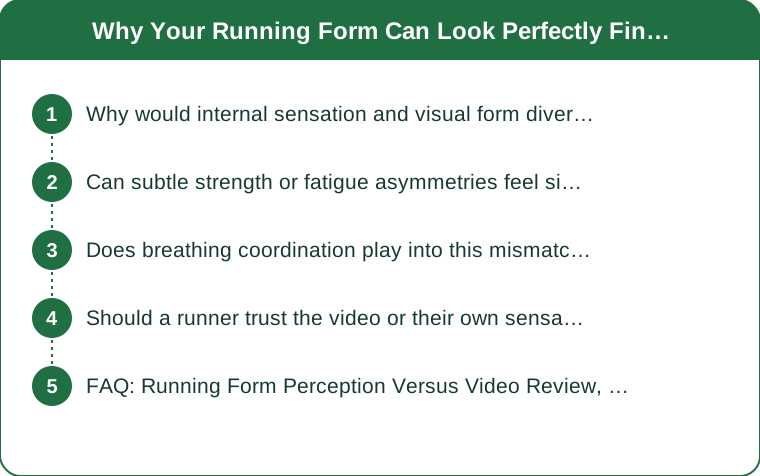
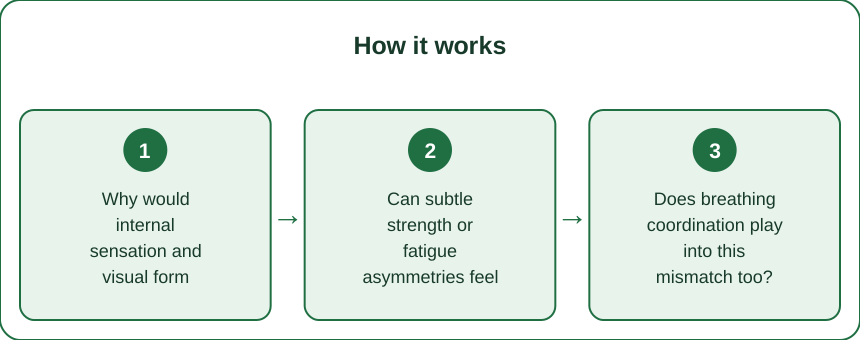
Why would internal sensation and visual form diverge like this?
Video captures external joint angles and body position, while a runner’s internal experience includes muscle fatigue, effort distribution, and breathing rhythm, none of which show up visually even when they meaningfully affect how the run feels.
Can subtle strength or fatigue asymmetries feel significant without changing visible form?
Yes — a runner can compensate for a mild strength imbalance or one-sided fatigue in ways that don’t visibly distort stride mechanics on video, but that compensation still requires extra effort that registers as the run simply feeling off.

Does breathing coordination play into this mismatch too?
Breathing rhythm and coordination with stride cadence significantly affect perceived effort and comfort, but breathing isn’t something a standard running form video captures at all, leaving a whole dimension of the experience invisible to video review.
Should a runner trust the video or their own sensation when the two disagree?
**Both are useful for different things — video is more reliable for objectively checking alignment and mechanics, while internal sensation is more reliable for noticing fatigue, effort imbalance, or discomfort that video can’t detect.
FAQ: Running Form Perception Versus Video Review, Answered
If form looks fine on video, should a persistent feeling of wrongness still be addressed?
Yes — a persistent feeling of something being off is worth investigating even with clean video form, since it may reflect fatigue, breathing, or asymmetry issues video doesn’t capture.
Are there ways to check for the internal factors that video misses?
Tracking perceived effort on each side, breathing rhythm, and recovery between runs offers insight into internal factors that visual form checks don’t address.
Does this mismatch mean video form analysis isn’t useful?
It’s still useful specifically for checking mechanical alignment and technique, just not for capturing subjective sensations like fatigue or breathing comfort.
TL;DR:
- Video captures joint angles and alignment but not internal sensations like fatigue or breathing
- Subtle asymmetries can be compensated for without visibly distorting stride mechanics
- Breathing coordination significantly affects felt comfort but isn’t visible on any form video
- Persistent wrongness despite clean video form is worth investigating, not dismissing
Keep Reading
This article is for general informational purposes only and is not medical advice. Always consult a qualified health professional for guidance specific to you.