Why Your Cadence Drops Before Your Pace Does
Quick Answer: As you fatigue, stride length is easier to maintain than stride frequency, so cadence falls while pace briefly holds — usually 3 to 6 steps per minute before pace visibly drops. A falling cadence means longer ground contact and more braking force per step, which is where late-run form breakdown and overuse strain come from. Watch cadence rather than pace as your fatigue signal. This is general information, not medical advice.
Look at the splits from a long run and the pace usually looks fine for a long time, then falls off a cliff near the end.
Look at cadence over the same run and it declines gradually and steadily from much earlier.
The cadence line is telling you what is actually happening. The pace line is telling you what you are managing to hold together, which is a different and much later signal.

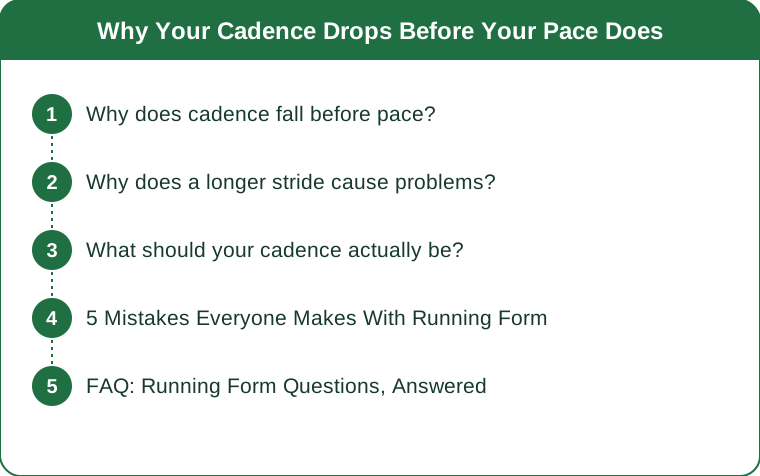
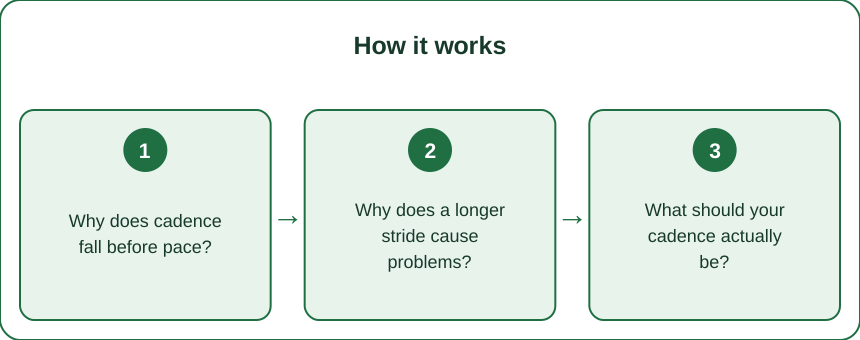
Why does cadence fall before pace?
Because your body compensates in a specific and predictable order.
Pace is the product of stride length and stride frequency. You can hold pace by maintaining either one while the other declines, and for a while that is exactly what happens.
Frequency is metabolically expensive to maintain. Turning the legs over quickly requires rapid, repeated activation, and that is what fades as fatigue accumulates. Reaching further with each step feels easier at the time.
So cadence falls and stride lengthens to compensate, keeping pace roughly constant. This is invisible without data and it feels like nothing is wrong. Typically cadence drops 3 to 6 steps per minute before pace moves at all.
But a longer stride at lower frequency is mechanically worse. The foot lands further ahead of the centre of mass, which increases braking force, lengthens ground contact time and raises impact loading. You are working harder per step to hold the same speed.
Then pace goes. Once stride length cannot extend further, the compensation is exhausted and speed drops quickly — which is the cliff at the end of the run, arriving long after the real problem started.
Why does a longer stride cause problems?
It is overstriding, and it changes the mechanics at every step.
The foot lands further in front of the hips. This creates a braking impulse — a force acting backward against your direction of travel — that has to be overcome on every stride.
Ground contact time increases. Longer contact means more time under load, and higher peak forces on the shin, knee and hip. Increased ground contact time is one of the more consistent correlates of running injury in the literature.
Impact is absorbed differently. A foot landing far ahead usually lands heel-first with a straighter knee, which transmits force up the leg rather than allowing the knee and hip to absorb it. This is the mechanism behind a lot of late-run shin and knee complaints.
And it costs energy. Braking and re-accelerating on each step is less economical than a shorter, quicker stride at the same pace, which is why running economy typically deteriorates alongside cadence.
One clarification worth making: the problem is not stride length itself, which increases naturally and correctly as you run faster. The problem is stride length increasing while speed does not — which is only possible if cadence is falling.

What should your cadence actually be?
Higher than yours probably is, and the target is relative rather than absolute.
The often-quoted 180 steps per minute is not a universal target. It came from observations of elite runners at racing speeds. Recreational runners at easy paces typically sit between 160 and 175, and that is normal.
The useful target is a 5 to 10 percent increase over your current average, if you currently sit below about 165. Research on cadence manipulation consistently finds that increases in this range reduce loading at the knee and hip meaningfully, while larger jumps feel unnatural and are not well tolerated.
Cadence naturally varies with pace, terrain and height. Faster running has higher cadence. Uphill has higher cadence, downhill lower. Taller runners tend to sit slightly lower. Comparing your number to someone else’s is not informative.
What matters is your own decline within a run. If you start a run at 170 and finish at 162, that 8-step drop is your fatigue signal, and it is far more actionable than any absolute number.
How to raise it: a metronome app or a playlist at your target step rate, used for short blocks of 3 to 5 minutes within an easy run. Do not try to hold a new cadence for a whole run — it is a skill that needs building in intervals, and forcing it for an hour usually produces calf soreness rather than adaptation.
5 Mistakes Everyone Makes With Running Form
1. Watching pace instead of cadence as the fatigue signal. Pace is a lagging indicator. By the time it drops, form has been degrading for a while.
2. Trying to lengthen the stride to run faster. Speed comes from pushing back against the ground more forcefully, not from reaching further forward. Reaching forward is braking.
3. Changing cadence by 15 or 20 steps at once. Too large a change alters loading dramatically and commonly produces calf and Achilles soreness. 5 to 10 percent is the range with evidence behind it.
4. Ignoring the last 20 percent of a long run. This is where form breaks down and where most people simply endure. Running the final section deliberately — shorter, quicker steps, relaxed shoulders, slightly slower pace — is more valuable than gritting through it, and the third mistake often happens because people try to fix this one too aggressively.
5. Assuming form problems are strength problems, or vice versa. Cadence is partly a habit and partly a capacity. If cadence collapses very early in runs, that points to endurance and strength; if it holds for an hour and then falls, that is normal fatigue and the fix is pacing.
FAQ: Running Form Questions, Answered
How do I measure cadence without a watch?
Count the number of times your right foot lands in 30 seconds and multiply by four. Do it at 10 minutes and again at the end of a long run — the difference between the two numbers is the information you actually want.
Will a higher cadence make me faster?
Not directly. It tends to improve running economy and reduce loading per step, both of which help over time, but cadence is not a speed lever on its own. Treat it as a mechanics and durability tool rather than a performance one.
Should I change my footstrike?
Generally no, not deliberately. Footstrike tends to shift naturally toward a midfoot landing when cadence increases, because the foot lands closer to the body. Changing footstrike directly redistributes load rather than reducing it, and doing it abruptly is a well-known route to calf and Achilles problems. Any persistent pain is a reason to see a physiotherapist — this is general information rather than medical advice.
TL;DR:
- Cadence falls before pace does, typically by 3 to 6 steps per minute, because stride length is easier to maintain than stride frequency under fatigue.
- A lower cadence at the same pace means overstriding — more braking force, longer ground contact, and higher loading.
- Target a 5 to 10 percent increase if you sit below about 165, built in 3 to 5 minute blocks, not held for whole runs.
- Watch your own within-run decline rather than any absolute number; that decline is your earliest and most useful fatigue signal.
The practical payoff is that you get a warning you did not have before. Instead of discovering in the last two kilometres that the run has fallen apart, you can see it starting at kilometre eight and respond — shorten the stride, quicken the feet, ease the pace slightly — while there is still something to protect. This is general information rather than medical advice; persistent pain should be assessed properly.
Keep Reading
This article is for general informational purposes only and is not medical advice. Always consult a qualified health professional for guidance specific to you.