Why Your Running Form Changes When the Sun Sets Earlier
Quick Answer: In low light your stride shortens, your cadence rises, and your foot strike moves slightly further forward as your body hedges against uncertain ground. This is a sensible adaptation, but it changes your loading pattern — so treat the first few weeks of dark running as a surface change, not a normal continuation of your training.
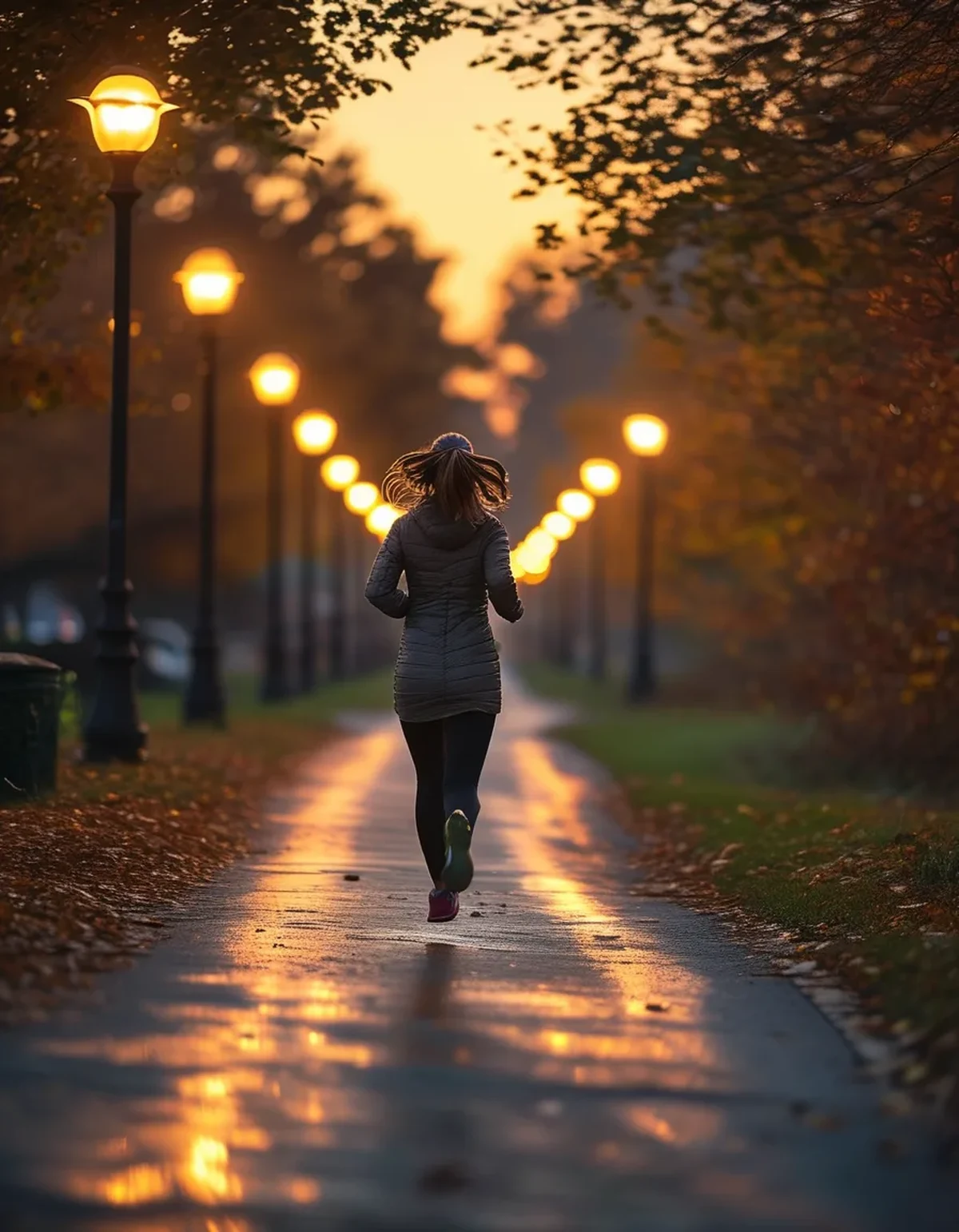
Same route, same effort, and your pace is 20 seconds slower per mile than it was three weeks ago.
You are also, though you have not noticed it, running with a visibly different stride.
The route did not change. Your ability to see it did.
What actually changes in your stride in low light?
Three measurable things, all of them the same underlying decision.
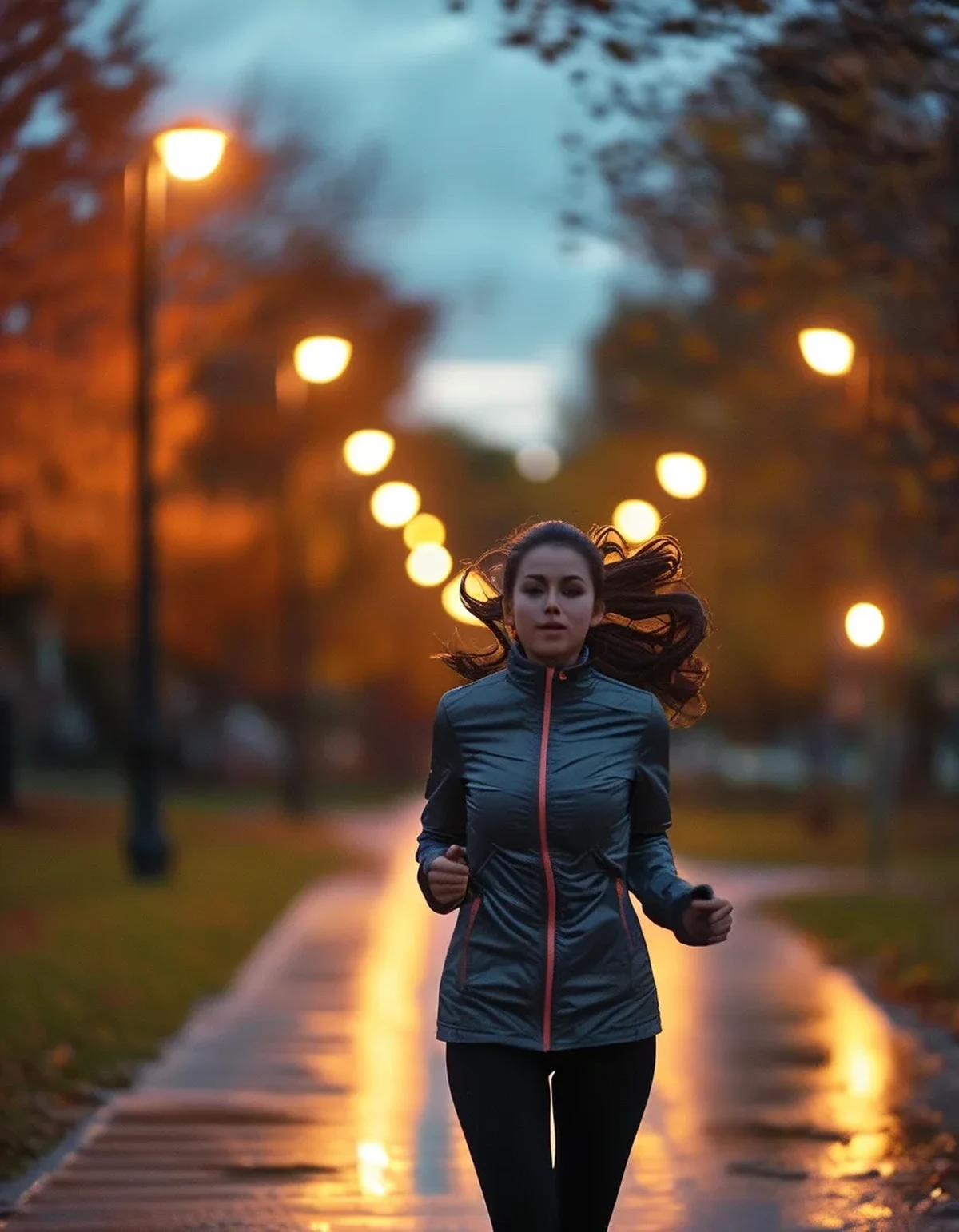
Stride length shortens. When visual information about the ground ahead is degraded, the nervous system reduces the distance it will commit to before the next foot placement. Studies of gait in reduced-visibility conditions consistently show shorter steps, and the effect appears well before conditions become genuinely dark.
Cadence rises to compensate, usually by 3 to 6 steps per minute. If you shorten your stride and hold your pace roughly constant, cadence has to go up — this part is arithmetic rather than physiology.
Ground contact time increases slightly. You spend marginally longer with the foot down, because a foot on the ground is providing information that your eyes are not.
There is also a postural change most people are entirely unaware of: a small forward head position as you look harder at the ground immediately ahead. Over 40 minutes that shows up as neck and upper back tightness that has nothing to do with your running and everything to do with squinting.
Is this adaptation a problem?
Mostly no, and partly yes.
The shortened stride and higher cadence are broadly protective. Higher cadence tends to reduce peak loading at the knee, and shorter steps reduce the consequences of an unexpected surface change. If you were going to design a gait for uncertain ground, it would look a lot like this.
The part worth managing is that it is a change in loading pattern arriving suddenly. Your tissues adapted over the summer to a particular stride, and in the space of about three weeks in September and October, that stride shifts. Rapid changes in loading pattern are associated with a higher rate of niggles regardless of whether the new pattern is better in isolation.
The calf and Achilles carry more of the work at higher cadence and shorter stride, which is why calf tightness in October is such a common complaint among people who ran comfortably all summer.
Treat the transition to dark running the way you would treat a switch from road to trail: same fitness, different demands, deserving of a two to three week easing period.
Myth vs Fact: Running in the Dark
Myth: You should focus on maintaining your summer pace. Fact: Your pace in the dark will be slower at the same effort and that is appropriate. Chasing summer paces on unlit routes is how people fall.
Myth: A headlamp fixes the form change entirely. Fact: A good headlamp substantially reduces it, but the shortened stride persists to some degree because peripheral vision remains limited. It is a large improvement rather than a complete fix.
Myth: Running in the dark means you should shorten your runs. Fact: Duration is fine. It is intensity and surface unpredictability that warrant caution. A long easy run on a familiar lit route is one of the better autumn sessions available.
Myth: Reflective gear is enough to be seen. Fact: Reflective material only returns light that hits it, which means it works for headlights and not much else. An active light — even a small blinking one — is what makes you visible from angles that do not have a light source pointed at you.
What should you actually change in your training?
Move your quality sessions. If you do one hard session a week, put it on the day you can run it in daylight — a weekend morning, or a lunch break. Intervals in the dark on an unfamiliar surface is the combination most likely to produce a rolled ankle.
Add calf work deliberately. Two sets of 15 slow calf raises, twice a week, from the start of the transition rather than after the tightness appears. This is a small intervention that addresses the specific tissue taking on the extra load.
Use a lit, familiar route for the first three weeks and accept the boredom. Route familiarity is the single largest determinant of how much your stride shortens, because it substitutes memory for vision.
Get an actual headlamp rather than relying on a phone or street lighting. Aim it slightly further ahead than feels natural — most people point it at their feet, which gives them the least useful information. Illuminating three to four meters ahead is what allows your stride to stay closer to its normal length.
And check your neck at the end of runs. If it is tight, you are looking down too hard, which usually means the light is aimed too close.
FAQ: Dark Running Questions, Answered
How long until my stride adapts to running in the dark?
Most of the adaptation to a familiar route happens within two to three weeks. On unfamiliar or unlit ground, the shortened stride persists indefinitely because it is a rational response to genuinely limited information.
Should I run on a treadmill instead through winter?
A mix works well. Treadmill running removes the surface uncertainty and lets you do quality sessions safely, while outdoor running keeps the specificity. Alternating rather than choosing avoids the drawbacks of either.
Is morning dark different from evening dark?
Yes, in two ways. Morning surfaces are more likely to be wet or frosted, which increases the surface uncertainty further. And your body is stiffer in the first waking hours, so morning dark runs deserve a longer walk-in and a slower first mile than evening ones.
TL;DR:
- Low light shortens your stride, raises cadence, and shifts load toward the calf and Achilles.
- The change is protective but sudden, so ease the first two to three weeks like a surface change.
- Move hard sessions into daylight and keep dark runs on familiar, lit routes.
- Use a real headlamp aimed three to four meters ahead, and add calf raises preemptively.
Your form did not deteriorate over three weeks in September. It adapted, quite sensibly, to the fact that you can no longer see where you are going — and the runners who manage that transition on purpose are the ones still running comfortably in January.
Keep Reading
This article is for general informational purposes only and is not medical advice. Always consult a qualified health professional for guidance specific to you.