Why Your Running Form Falls Apart in the Exact Same Way Every Time Your Legs Get Tired
Quick Answer: A consistent, repeatable form breakdown late in a run (hip drop, overstriding, arm crossing the body) usually points to one specific muscle group fatiguing before the others around it, forcing a compensatory movement pattern — it’s not random fatigue, it’s a predictable weak-link signature specific to you.
You’ve noticed it happens almost exactly the same way every long run — your form is clean for the first few miles, then right around the same point, the same specific breakdown shows up like clockwork.

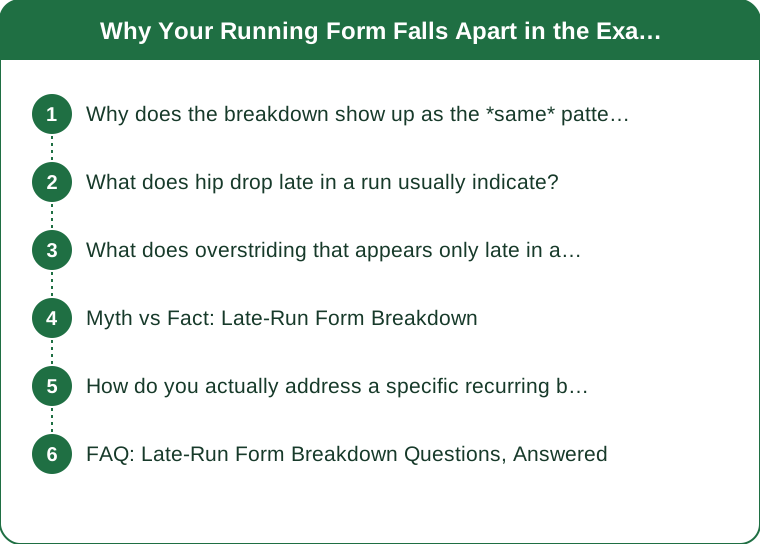
Why does the breakdown show up as the same pattern every time?
Your body has a consistent fatigue order — the specific muscles that tire first in your particular running mechanics tend to be the same ones every run, since your form, strength imbalances, and running history are relatively stable session to session. Once that muscle group fatigues past a threshold, your body compensates in a specific, repeatable way to keep moving, which is why the same breakdown pattern recurs rather than a random new issue each time.
What does hip drop late in a run usually indicate?
Hip drop (one hip dropping visibly with each stride on the opposite-leg stance phase) most often points to glute medius fatigue — this muscle is responsible for pelvis stabilization during single-leg stance, and it’s commonly under-trained relative to the demand running places on it, making it a frequent first-to-fatigue weak link.
What does overstriding that appears only late in a run usually indicate?
This pattern often points to hip flexor and hamstring fatigue reducing your ability to actively pull the foot back under your center of mass at footstrike, so the foot lands further forward than earlier in the run — not because you’re consciously changing your stride, but because the muscles that maintain proper foot placement are simply more tired.

Myth vs Fact: Late-Run Form Breakdown
Myth: Form breakdown late in a run is just an unavoidable part of fatigue. Fact: while some breakdown is normal, a strong, repeatable, specific pattern usually indicates a targetable strength or endurance gap in one particular muscle group, not generic total-body tiredness.
Myth: You just need more running mileage to fix it. Fact: more running volume without targeted strength work for the specific fatiguing muscle often just delays the same breakdown pattern to a slightly later mile, rather than resolving it.
How do you actually address a specific recurring breakdown pattern?
Targeted strength work for the specific muscle group identified by your breakdown pattern (glute medius work for hip drop, hip flexor and posterior chain work for late overstriding) tends to shift the fatigue threshold later, delaying or reducing the breakdown rather than just running through more volume and hoping form holds.
FAQ: Late-Run Form Breakdown Questions, Answered
How can I tell exactly which muscle is the weak link?
A running gait analysis (many running stores or physical therapists offer this) or reviewing slow-motion video of your own late-run form are the most reliable ways to identify the specific pattern, rather than guessing from how it feels.
Is this pattern something to address, or just accept as part of long-distance running?
It’s worth addressing if it’s associated with recurring soreness or injury risk in a specific area — a completely painless, purely aesthetic form change late in easy runs is a lower priority than one that correlates with actual discomfort or injury history.
This is general information, not medical advice — persistent pain associated with a specific form pattern should be evaluated by a professional.
TL;DR:
- A repeatable late-run form breakdown reflects a consistent, specific fatigue order in your body
- Hip drop commonly points to glute medius fatigue affecting pelvis stability
- Late overstriding often points to hip flexor and hamstring fatigue, not a conscious change
- Targeted strength work for the specific weak link shifts the pattern later than volume alone
Keep Reading
This article is for general informational purposes only and is not medical advice. Always consult a qualified health professional for guidance specific to you.