Why Your Running Form Changes When You Run in the Dark
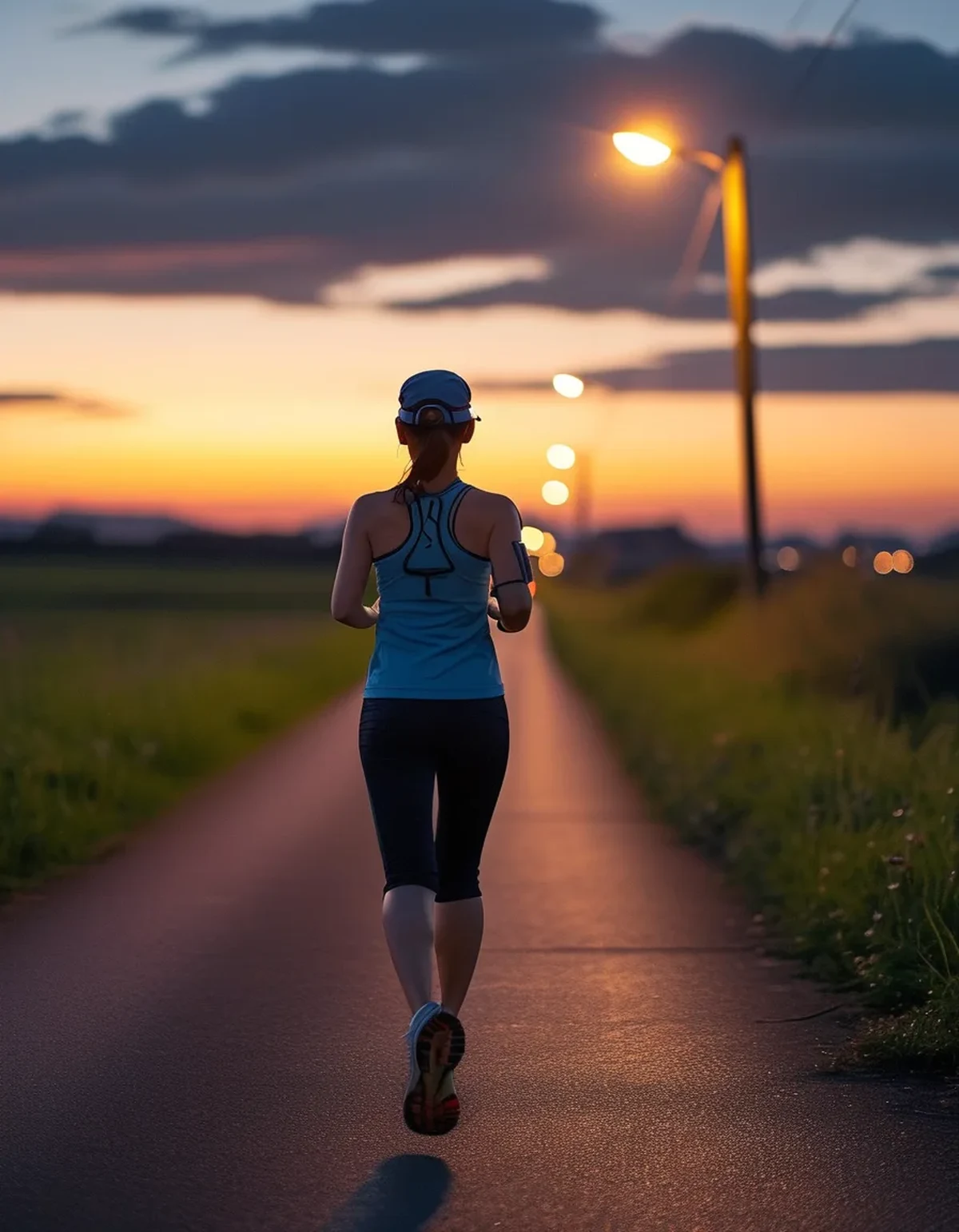
Quick Answer: Running gait is planned several steps ahead using visual information about the ground. In low light you cannot gather that information, so your nervous system defaults to a conservative pattern - shorter steps, higher cadence, flatter foot placement, more knee flexion at contact, and more muscular co-contraction. It is a deliberate stability strategy, and it costs energy. That is why the same pace feels harder after dark. Better light restores the stride more than any form cue will.
You are not running badly at night.
You are running the way a body runs when it cannot see where it is going.
How does vision control your stride?
It plans two steps ahead, continuously, without any conscious involvement.
Runners gather visual information about upcoming terrain roughly two steps in advance. Gaze research on walking and running over uneven ground shows people look about one and a half to two steps ahead, and use that information to place the next foot. The step you are taking now was planned while you were looking somewhere else.
That planning sets step length before contact. Your foot placement is committed in flight, based on where your visual system believes the ground is. When that information is missing or unreliable, the safest assumption is that the ground might not be where you expect.
Peripheral vision does more of this than central vision. The lower visual field in particular contributes heavily to foot placement, which is why looking down at your feet does not help - it removes the useful preview and gives you information about ground you have already committed to.
Low light degrades exactly the information the system relies on. Contrast sensitivity drops sharply in dim conditions, and contrast - not brightness - is what reveals edges, kerbs, roots, and changes in surface. A path can be visible and still be unreadable.
So the nervous system switches strategies. Without reliable preview, it adopts a pattern that tolerates surprises: land closer to the body, keep the knee bent, keep the centre of mass lower and more supported, and get the next foot down sooner.
That is a sensible response, not a fault. It is simply expensive.
What specifically changes in the gait?
Five measurable things, all pointing the same direction.
Step length shortens and cadence rises. Shorter steps mean less time in the air and a foot under you sooner - the fastest way to recover from an unexpected surface. Expect cadence to rise several steps per minute at the same pace.
Ground contact time increases. You spend longer with the foot planted, gathering information through the foot and stabilising before pushing off. Longer contact directly costs running economy.
Knee flexion at contact increases. A more bent knee acts as a shock absorber for an impact you did not fully predict. It is also less efficient, because a bent knee stores and returns less elastic energy than a stiffer one.
Co-contraction rises around the ankle and knee. Muscles on both sides of a joint fire together to stiffen it against unexpected loads. This is a well documented response to uncertain terrain, and it burns energy without producing forward motion.
Foot placement becomes flatter and more central. A flat foot has a larger base and more surface information than a heel or forefoot landing, so the system defaults toward it when uncertain.
Together these explain the effort mismatch. The same pace at night can cost measurably more oxygen than the same pace in daylight, because you are running with a stiffer, shorter, more braced stride. The watch says the pace is the same; your legs are correct that it is harder.
Does a headlamp fix it?
Substantially - but the specification of the light matters more than its existence.
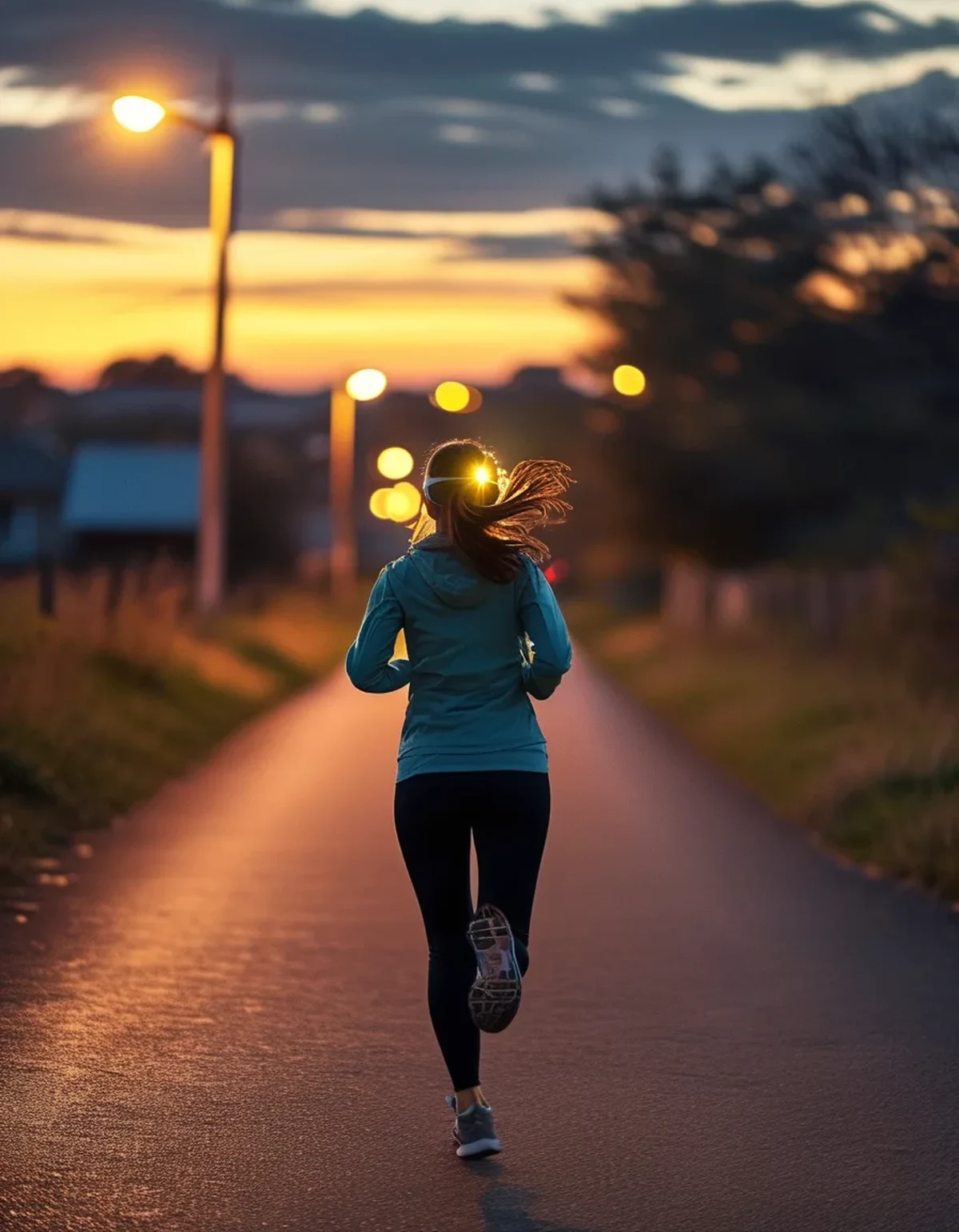
Brightness is not the key variable; beam pattern is. A narrow spot beam lights a small circle several metres ahead and leaves the immediate foreground dark, which does not give you the two-step preview you need. A wide flood pattern is far better for gait.
Light needs to reach where you look. Aim the beam to cover roughly two to four metres ahead, not thirty. Long-throw beams are for spotting hazards; the near field is what your foot placement uses.
A head-mounted light creates flat shadows and hides texture. Because it shines from your eye line, it illuminates surfaces face-on and removes the shadows that reveal edges and depth. This is why roots and potholes disappear under a headlamp. A waist-mounted or chest-mounted light throws shadows sideways and reveals texture much better.
The best solution is two lights at different heights. A waist light for terrain reading and a head light for looking around is what experienced trail runners use, and the reason is precisely this shadow problem.
Beam colour and warmth make a modest difference. Warmer light tends to render texture and contrast slightly better on natural surfaces than very cool white, though the effect is smaller than beam placement.
And your eyes need consistency. Running in and out of streetlight pools forces constant adaptation, and the eye adapts to darkness far more slowly than to brightness. A steady moderate light is easier to run under than an alternation of bright and dark - which is why lit suburban streets can be harder than an unlit path with a good lamp.
What Nobody Tells You About Running at Night
Your pace will be slower and your heart rate higher, and both are correct. The braced, shortened stride costs energy, so effort-based training is far more reliable than pace-based training after dark. Judging an evening run by your daylight paces produces false conclusions about fitness.
The adaptation is not just visual - it is anticipatory. Even on a perfectly smooth, well-known route, the conservative pattern appears, because the system is responding to the absence of information rather than to actual hazards. Familiarity helps but does not eliminate it.
Downhills are affected far more than uphills. Downhill running depends heavily on accurate visual preview because the consequences of a misplaced foot are larger and the correction time is shorter. Most people slow disproportionately on night descents, correctly.
Cold and dark arrive together in autumn, and they compound. Cooler tissue is stiffer and the visual system is degraded at the same time, which is why late-autumn evening runs feel dramatically harder than the same route in September. It is two effects, not one.
Wet surfaces at night are worse than either alone. Water reflects light back and destroys contrast, so a wet path under a headlamp gives you less information than a dry one in the same light.
And a genuinely useful trick: run a route you know in the direction you know it. Route familiarity provides some of the preview information vision cannot, and reversing a familiar route removes most of that benefit.
How should I train around it?
Change what you measure, and use night runs for what they are good at.
Run by effort or heart rate after dark, not by pace. A 30 to 45 second per mile difference at the same effort is unremarkable on an unlit route. Recording it as a slow run in your log distorts your training picture.
Put quality sessions in daylight where possible. Intervals and tempo work depend on being able to hit paces, and the night stride makes that unreliable. Use dark evenings for easy volume, which is what most of your running should be anyway.
If you must do speed work at night, use a well-lit, flat, familiar surface. A track or a lit loop removes most of the visual uncertainty and lets the stride open up.
Do not try to override the pattern with form cues. Deliberately lengthening your stride to fight a stability adaptation on ground you cannot see is how people get hurt. The adaptation exists for a reason.
Invest in the light before you invest in anything else. A good wide-beam waist light changes night running more than any shoe, cue, or drill will. It is the direct fix for the actual cause.
And build the seasonal transition in gradually. As sunset moves earlier through autumn, more of your weekly running quietly shifts into low light - often without anyone noticing the change in training stimulus. Expect paces to drift, and do not read that drift as lost fitness.
FAQ: Running in the Dark Questions, Answered
Will running in the dark make my form worse permanently?
No. The changes are a real-time response to visual uncertainty and disappear as soon as you can see properly. There is no evidence that regular night running degrades daylight gait.
Is running in the dark higher risk for injury?
The main risks are trips and falls rather than gradual overuse injuries. Shortened, more cautious steps actually reduce impact peak forces, so the loading itself is not the concern. Surface hazards and traffic visibility are.
Head torch or waist light - which should I buy first?
Waist light, if you can only have one, for the shadow reason - it reveals ground texture that a head-mounted beam flattens out. A head torch is better for being seen and for looking around, so most regular night runners eventually carry both.
TL;DR:
- Running gait is planned about two steps ahead using visual information, and low light removes it.
- The result is shorter steps, higher cadence, longer ground contact, more knee bend, and more co-contraction - a stability strategy that costs energy.
- The same pace genuinely costs more after dark, so train by effort, not pace.
- Beam pattern beats brightness; a waist-mounted light reveals texture that a head torch flattens.
- Save quality sessions for daylight or lit flat surfaces, and never force a longer stride on ground you cannot see.
Move your headlamp to your waist on the next evening run and watch how much more of the ground you can actually read.
Keep Reading
This article is for general informational purposes only and is not medical advice. Always consult a qualified health professional for guidance specific to you.