Why Your Running Form Changes the Moment You Step Onto Trail
Quick Answer: On trail, your body shortens its stride and raises cadence automatically because it cannot predict where the ground will be. Contact time drops, arms swing wider for balance, and your gaze moves further ahead. Expect roughly a 5 to 10 percent higher cadence and a noticeably shorter stride than on road at the same effort. Pace slows and heart rate stays similar — that is the trade, and it is not a fitness problem.
You run a comfortable pace on the road every week.
First trail run, the same effort produces a pace a minute slower and you feel like you have forgotten how to run.
You have not. Your form changed on purpose.

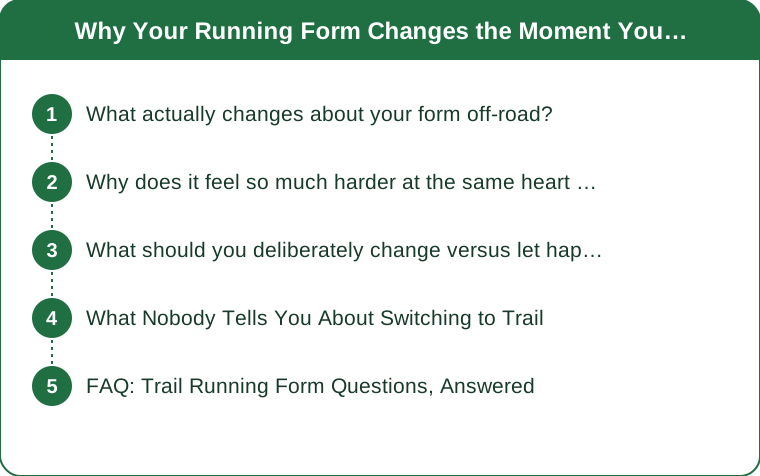
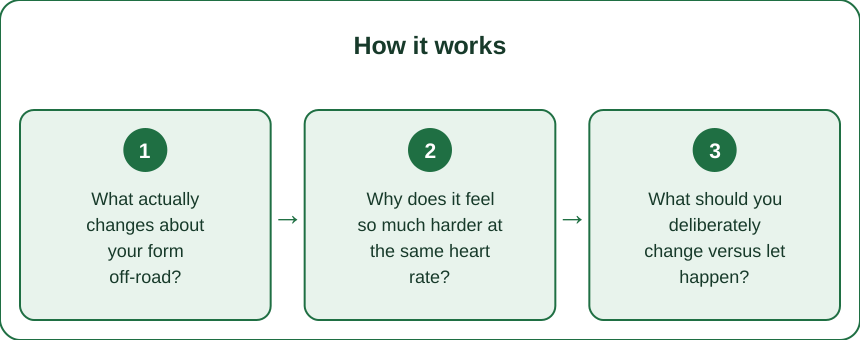
What actually changes about your form off-road?
Six adaptations, all of them protective, all of them automatic.
Stride shortens. A shorter stride means your foot lands closer under your body, where you can correct quickly if the ground is not where you expected.
Cadence rises to compensate. Shorter steps at the same speed require more of them — typically 5 to 10 percent more on technical ground.
Ground contact time drops. Less time on any single foot placement means less exposure to a rock rolling or a root shifting.
Arms move wider and lower. They become balance instruments rather than metronomes. The tight, forward arm carriage that works on road is actively unhelpful on trail.
Your gaze moves further ahead. On road you can look at the horizon. On trail, you are reading the ground three to five metres ahead and remembering it — your feet land where your eyes were a second ago.
Trunk stiffness increases. Your core works harder to keep your torso stable while your legs deal with variable ground, which is a large part of why trail running feels harder at the same pace.
Why does it feel so much harder at the same heart rate?
Because a lot of the work is invisible on a watch.
Stabilising muscles are doing real work. Ankles, hips and trunk are constantly making small corrections that never appear as pace.
Every surface change costs energy. Soft ground absorbs energy that a road returns. Running on leaf litter or sand can cost meaningfully more at the same speed.
Elevation hides in ‘flat’ trails. A trail described as flat often has constant small ups and downs that add up to significant climbing, and even short climbs raise effort substantially.
Cognitive load is real. Reading terrain continuously is tiring in a way road running is not, and it contributes to how hard a run feels.
Your pace is a poor guide, so use effort. Trail runners generally run by perceived effort or heart rate, not by pace, because pace on trail reflects terrain far more than fitness.
Seasonal note: as autumn arrives, wet leaves and shorter light change trail surfaces significantly. The same route you ran comfortably in summer can demand a shorter stride and more caution, and your pace will drop for reasons that have nothing to do with your training.

What should you deliberately change versus let happen?
Most of it happens by itself. Three things are worth doing consciously.
Let happen: stride length, cadence, contact time. Your body handles these better than your conscious attention does. Trying to hold a road stride on trail is how people trip.
Do consciously: look further ahead. The most common beginner error is watching your feet. Look three to five metres ahead and trust your peripheral vision for the immediate step.
Do consciously: relax your arms and unlock your shoulders. Tension travels down. Wide, loose arms are correct here even though they feel sloppy compared with road form.
Do consciously: shorten further on descents, not longer. The instinct on a downhill is to reach out with a long stride and brake with the heel, which is hard on the knees and slower. Quick, light, short steps are both faster and safer.
Uphill: shorten stride, keep cadence, and be willing to power-hike. Walking steep sections is standard practice on trail, not a failure — it is often more efficient than running them.
Give it three or four runs. The clumsiness resolves quickly as your ankles and eyes adapt. Most people feel noticeably more coordinated by the third trail run.
This is general information, not medical advice.
What Nobody Tells You About Switching to Trail
Your ankles will be sore before your legs are. Lateral stability work you never do on road suddenly becomes the limiting factor, and it takes a few weeks.
Your road pace will feel oddly easy afterwards. Predictable ground after a few weeks of trail feels almost effortless, and many runners find their road cadence has improved without trying.
Downhill is where you get injured, not uphill. Eccentric loading on descents produces most trail soreness and most of the falls. Take descents conservatively for the first month.
Shoes matter less than people say, until they suddenly matter a lot. Road shoes are fine on smooth trail and genuinely unsafe on wet rock or steep mud. The grip, not the cushioning, is the difference.
You will trip. Everyone trips. The skill is not avoiding it entirely — it is learning to recover, which comes from keeping your feet under you and your gaze ahead.
And the thing that surprises even experienced road runners: your heart rate can be lower on trail while the run feels harder, because muscular and cognitive load are high while cardiovascular demand is moderate. The watch will disagree with your legs, and your legs are right.
FAQ: Trail Running Form Questions, Answered
How much slower should I expect to be?
Commonly one to two minutes per kilometre slower than road at the same effort, more on technical terrain. Compare effort, never pace.
Should I try to keep my road cadence?
No — expect it to rise. Forcing a road stride on uneven ground is the main cause of trips.
Where should I look?
Three to five metres ahead, not at your feet. Your brain stores the terrain and places your feet from memory.
Do I need trail shoes?
For smooth paths, no. For wet, rocky or steep ground, the extra grip is a safety issue rather than a preference.
Is walking the hills allowed?
Yes, and experienced trail runners do it routinely. On steep gradients power-hiking is often faster and always cheaper energetically.
Why are my ankles sore after trail runs?
Stabilising muscles that road running barely uses are suddenly working hard. It settles within a few weeks; build trail volume gradually rather than all at once.
Will trail running change my road form?
Often yes, for the better — many runners find their cadence increases and their stride shortens slightly on road too.
TL;DR:
- Trail form changes automatically: shorter stride, higher cadence, shorter contact time, wider arms.
- Effort stays similar while pace drops — judge trail runs by effort, not pace.
- Consciously control only three things: gaze three to five metres ahead, relaxed arms, shorter steps on descents.
- Ankles get sore before legs. Build trail volume gradually.
- Descents cause most soreness and most falls. Be conservative for the first month.
On your next trail run, fix your eyes a few metres ahead and stop watching your feet. Everything else sorts itself out.
Keep Reading
This article is for general informational purposes only and is not medical advice. Always consult a qualified health professional for guidance specific to you.