Why Your Running Form Changes More on a Treadmill Incline Than It Does on Flat Ground
Quick Answer: Treadmill incline forces a shorter stride and more forward lean than an equivalent outdoor hill, because the moving belt removes the natural push-off variability your body uses on real terrain, which means your form adapts differently — and sometimes less efficiently — than it would climbing an actual hill.
It’s easy to assume 5% incline on a treadmill feels and moves your body the same way a 5% grade hill would outside — but the mechanics diverge more than most runners expect.

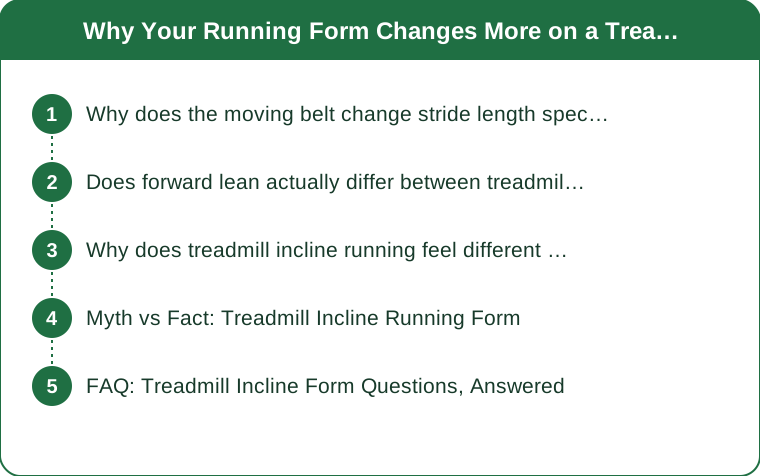
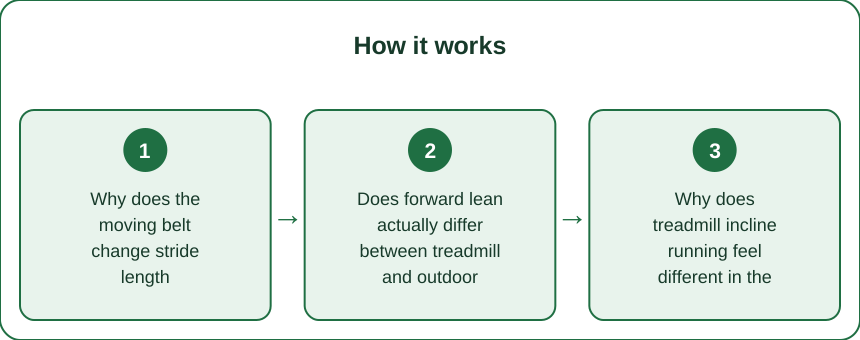
Why does the moving belt change stride length specifically?
On outdoor terrain, your foot controls exactly where and how each step lands relative to the changing ground, but a treadmill belt moves at a fixed pace under you, which removes the natural stride adjustments your body makes climbing real terrain, often resulting in a shorter, choppier stride at the same incline percentage.
Does forward lean actually differ between treadmill and outdoor incline?
Yes — many runners over-lean forward on a treadmill incline as a compensation for the belt’s consistent pace, more than they would naturally lean climbing an equivalent outdoor grade, where the terrain itself provides more subtle postural feedback. This over-lean can shift more load onto the lower back and hip flexors than outdoor hill running typically does.

Why does treadmill incline running feel different in the calves and Achilles specifically?
The fixed belt speed reduces the natural push-off variation that outdoor terrain allows, concentrating more repetitive, similar-angle stress on the calves and Achilles tendon than the more varied loading pattern of real hills, which is part of why treadmill incline sessions can produce a different type of soreness than outdoor hill runs of similar difficulty.
Myth vs Fact: Treadmill Incline Running Form
Myth: 5% incline on a treadmill is mechanically the same as a 5% grade hill outside. Fact: The fixed belt speed changes stride length and lean pattern compared to natural terrain.
Myth: Treadmill incline training doesn’t transfer to outdoor hill running. Fact: It still builds relevant strength and cardiovascular adaptation, just with somewhat different mechanics than the outdoor equivalent.
Myth: Over-leaning on treadmill incline is just a minor style quirk. Fact: Consistent over-lean can shift load onto the lower back and hip flexors in a way that compounds with volume.
FAQ: Treadmill Incline Form Questions, Answered
How can I check if I’m over-leaning on treadmill incline?
Having someone film you from the side, or checking your reflection if your treadmill faces a mirror, can reveal whether your torso lean exceeds what feels natural on an equivalent outdoor hill.
Should I use a shorter stride intentionally on treadmill incline?
A slightly shorter, quicker stride is generally recommended for incline treadmill work, as it reduces strain compared to trying to force a long, outdoor-style stride against the moving belt.
Is treadmill incline still worth doing if it doesn’t perfectly mimic outdoor hills?
Yes — it still provides valuable strength and cardiovascular benefit, especially when outdoor hills aren’t accessible, even though the specific mechanics differ somewhat.
TL;DR:
- Treadmill incline forces a shorter stride than outdoor hills because the belt controls the pace, not your foot
- Many runners over-lean on treadmill incline more than they would climbing an equivalent outdoor grade
- Reduced push-off variation concentrates repetitive stress differently on calves and Achilles
- Treadmill incline still builds real fitness — just with somewhat different mechanics than outdoor hills
Next incline session, focus on a shorter, controlled stride and check your lean — the treadmill rewards different form than the hill outside does.
Keep Reading
This article is for general informational purposes only and is not medical advice. Always consult a qualified health professional for guidance specific to you.