Your Running Cadence Drops on the Days You Feel Strongest
Quick Answer: When you feel strong, you instinctively lengthen your stride rather than quicken it, which drops cadence and increases impact per step. Your watch shows a good pace and a suspiciously low step rate. The fix is not to force a metronome cadence but to notice that ‘feeling powerful’ is your body’s cue to over-stride, and to convert that feeling into turnover instead of reach.
You had one of those runs. Legs felt springy, breathing easy, pace better than it had any right to be.
Then you looked at the data: cadence 164, down from your usual 174. On your best run of the month.

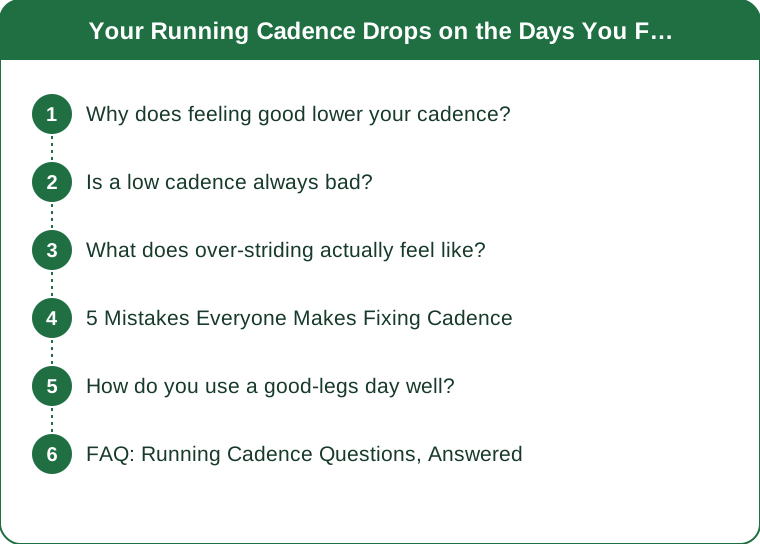
Why does feeling good lower your cadence?
Because power feels like reach, not turnover.
When your legs feel strong, the sensation you are chasing is push — a big, satisfying drive off the ground. Big drives produce long strides. Long strides mean more time in the air per step, which means fewer steps per minute. The pace improves because stride length went up, not because you got more efficient.
The problem is that stride length is the more expensive of the two ways to go faster. Each step in a longer stride lands with your foot further ahead of your center of mass, which creates a braking force and a bigger impact peak at the knee and hip. Increasing cadence at the same pace does the opposite — shorter steps, foot landing closer underneath you, lower peak forces.
So the runs where you feel most invincible are frequently the runs applying the most load per step. That combination — high confidence, high impact, low perceived effort — is why good weeks often precede sore weeks.
Is a low cadence always bad?
No, and the 180 steps-per-minute rule is more folklore than physiology.
Cadence varies legitimately with height, leg length, pace, and terrain. A tall runner at an easy pace may sit comfortably at 165 and be perfectly efficient. Someone shorter may naturally run at 182. There is no universal correct number.
What matters is your own pattern:
- Cadence should rise as pace rises. If you speed up and your cadence stays flat, you are lengthening stride to go faster, which is the expensive route.
- Cadence should be reasonably stable at a given pace. If your easy-pace cadence swings 10+ spm between runs, something is changing — usually fatigue on the low days and over-striding on the high-energy ones.
- A sudden drop of 8-10 spm at your usual easy pace is worth noticing, in either direction, because it means your mechanics changed and you did not choose to change them.
So do not chase 180. Chase consistency at each pace, and watch the relationship between the two numbers rather than either alone.
What does over-striding actually feel like?
Most people cannot feel it, which is the entire problem. But there are proxies.
Audible heel strike. If your footfall is loud and you can hear a distinct slap, your foot is landing well ahead of you. Quiet running is short-stride running.
A sense of reaching with the front leg. If your attention is on where your front foot is going to land, you are over-striding. Efficient running feels like the back leg is doing the work.
Bouncing. High vertical oscillation shows up as a feeling of springing upward rather than forward. That vertical movement is stride length converted into height.
Shins working hard on easy runs. Your tibialis anterior has to control the foot on the way down after a long reach. Shin fatigue on an easy run is a fairly reliable over-striding signal.
A quick self-test: run 30 seconds at your normal easy pace and count your right foot strikes, then double it. Then run 30 seconds deliberately taking quick small steps at the same pace and count again. If the second one feels absurdly fast and your pace held, your default is longer than it needs to be.

5 Mistakes Everyone Makes Fixing Cadence
1. Chasing 180 regardless of pace. Forcing 180 during an easy 9:30 pace run produces a shuffling, tense gait that is less efficient than your natural stride. Match cadence targets to pace.
2. Changing it all at once. Jumping from 164 to 178 in a week loads different tissues abruptly and commonly produces calf and Achilles complaints. Move in 5% increments over three to four weeks.
3. Trying to increase cadence by moving your feet faster while keeping the same reach. That produces a frantic, high-effort gait. Cadence increases correctly when the stride gets shorter, not when the legs get busier.
4. Only practicing it on hard runs. Cadence changes stick when rehearsed at easy pace, where you have attention to spare. Doing it only during intervals means the pattern never becomes default.
5. Ignoring what fatigue does to it. Cadence drifts down as you tire — that is normal and not a form failure. The useful metric is the cadence in the first half of your run, not the average across a long one.
How do you use a good-legs day well?
Redirect the feeling instead of suppressing it.
On a day when your legs feel strong, the temptation is to run further or faster than planned. Both are fine occasionally, but both amplify the over-striding pattern that the good feeling produced in the first place.
A better use:
Run the planned distance at the planned pace with deliberately higher turnover. You will feel like you are wasting the good legs. You are actually rehearsing efficient mechanics under the easiest possible conditions, which is exactly when technique work works.
Do strides. Six to eight 20-second accelerations at the end of an easy run, with full recovery. Strides naturally produce high cadence and good posture, and they are the cheapest form practice available.
Add a short hill segment. Uphill running forces shorter steps and higher cadence automatically. Two or three 45-second hill efforts on a strong day give you the stimulus without the over-striding.
Save the long-stride, big-effort runs for days when they are on the plan, not days when your legs offered.
FAQ: Running Cadence Questions, Answered
Should I use a metronome app?
For short blocks, yes. Run five minutes with a metronome set 5% above your current easy-run cadence, then five minutes without, and repeat twice. Full-run metronome use tends to make people tense and does not build an internal sense of the rhythm. Music at a matching BPM works similarly and feels less clinical.
My cadence is fine but I still get knee pain. Is form the problem?
Possibly, but cadence is only one input. Volume increases, shoe changes, running surface, and hip strength all contribute. If pain is consistent and localized rather than general soreness, get it assessed rather than adjusting form variables one at a time and hoping. This is general information, not medical advice.
Does cadence change on trails versus roads?
Yes, substantially, and that is appropriate. Technical trail running produces shorter, more variable steps and often a higher cadence at a much slower pace. Do not compare trail cadence to road cadence — they are different activities wearing the same name.
TL;DR:
- Feeling strong makes you lengthen your stride, which drops cadence and raises impact per step at the same pace.
- Forget the universal 180 target — watch whether your cadence rises with pace and stays stable at a given pace.
- Over-striding shows up as loud footfalls, a sense of reaching, bouncing, and shin fatigue on easy runs.
- Change cadence in 5% steps over three to four weeks, practiced at easy pace, not by moving your legs frantically.
- On good-legs days, convert the feeling into turnover, strides, or a short hill rather than a longer reach.
What makes this pattern worth watching is its timing. It shows up in the best weeks of a training block, disguised as progress, and it is one of the few form issues where the sensation of running well and the mechanics of running well point in opposite directions. Notice the springy day and take shorter steps on it — that is the whole skill.
Keep Reading
This article is for general informational purposes only and is not medical advice. Always consult a qualified health professional for guidance specific to you.