Why Your Cadence Changes on Its Own When the Temperature Drops
Quick Answer: Cadence is not a fixed personal setting - it self-adjusts to speed, fatigue, terrain, and how compliant your muscles and tendons currently are. In cooler conditions, tissue is stiffer at the start of a run, your warm-up takes longer, and you naturally take slightly shorter, quicker steps until you are warm. That adjustment is your body optimising, not degrading. Forcing a summer cadence onto a cold-start run tends to produce worse economy, not better form.
Here is what actually moves your cadence, and when it is worth intervening.

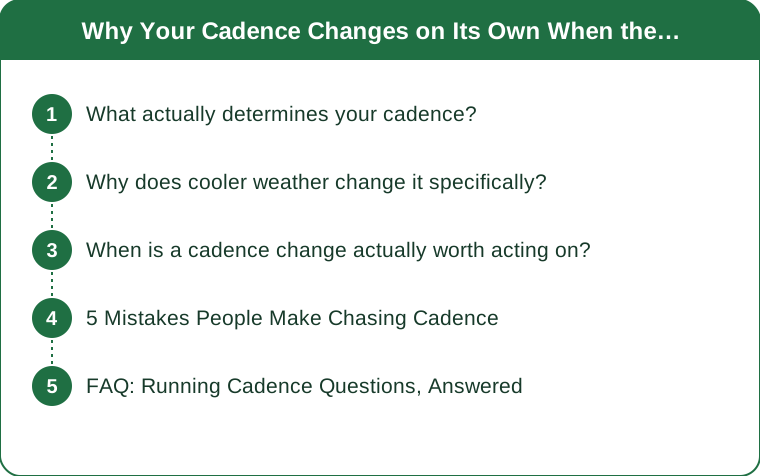
What actually determines your cadence?
Several inputs, and almost none of them are conscious.
Speed is the largest factor by far. Cadence rises with pace for essentially everyone. Comparing your cadence at an easy pace to a magic number derived from race running is comparing different things - and it is the most common source of unnecessary form anxiety.
Leg length and body proportions set a personal baseline. Longer legs generally swing at a lower natural frequency. There is no universal correct number, and the widely quoted 180 steps per minute came from observations of elite runners at race pace rather than from recreational runners on an easy Sunday.
Tissue stiffness changes stride mechanics. Running uses elastic recoil from tendons - especially the Achilles - to return energy with each step. The properties of that spring change with temperature and with how warmed up you are, which directly affects how long each ground contact lasts.
Fatigue reduces stride length before it reduces cadence. As you tire, the usual pattern is a shorter stride at a similar or slightly higher cadence - which is why a long run’s later miles can show a stable cadence with a falling pace.
And terrain and surface matter. Uphill running shortens the stride and raises cadence; downhill lengthens it. Soft surfaces absorb elastic return and change the pattern again.
Which means a single cadence number is close to meaningless without the context of pace, terrain, temperature, and where you were in the run.
Why does cooler weather change it specifically?
Three mechanisms, all pointing toward shorter, quicker early steps.
Muscle and tendon are less compliant when cold. Elastic tissue behaves differently at lower temperatures, which means less energy return per step at the start of a cool-weather run. Less recoil means a shorter stride, and a shorter stride at the same pace means more steps.
Your warm-up takes longer. The first mile of a run in cool air simply is not the same as the first mile in August. What used to be a two-minute settling-in period becomes five or ten, and cadence during that window is genuinely different from the rest of the run.
And clothing changes your mechanics slightly. Extra layers, longer tights, and a jacket all add small restrictions to arm swing and hip movement. Arm swing and leg cadence are coupled - restrict one and the other adjusts.
There is a footwear component too. Midsole foams stiffen at lower temperatures. The same shoe genuinely returns energy differently on a cold morning, and shoes with highly temperature-sensitive foams change noticeably.
All of which means your autumn data is not directly comparable to your summer data. A cadence drop of a few steps per minute across September, with no change in training, is a seasonal artefact rather than a decline - and reading it as regression leads people to make changes that were never needed.
The correct response is a longer warm-up, not a correction. Give the first mile or two at genuinely easy effort, and compare cadence from mile three onward if you want a fair number.

When is a cadence change actually worth acting on?
Rarely, and the useful cases are specific.
A genuinely low cadence at a given pace - often described as under about 160 at easy running pace - is worth examining, because it usually indicates overstriding: reaching the foot out well ahead of the body, which increases braking forces and loading through the knee.
The intervention is small. Increasing cadence by roughly 5 to 10% - not more - reduces stride length and vertical oscillation and lowers loading at the knee. This is one of the better-supported form interventions available, particularly for runners with recurring knee complaints.
Bigger changes tend to backfire. Forcing a much higher cadence usually costs running economy, because you are overriding a self-optimised pattern. Your body’s chosen cadence at a given speed is generally close to metabolically optimal for you.
Change it gradually and only in short segments. A few minutes at a slightly raised cadence within an otherwise normal run, repeated over weeks, works far better than an entire run spent counting steps.
And if pain is the reason you are looking at cadence, address the pain properly. Cadence adjustment is a useful tool for specific loading problems, not a general fix, and persistent running pain deserves a proper assessment rather than a metronome.
A far more productive place to look for most runners: total load progression. How much your weekly mileage jumped, how quickly you added intensity, and how much rest you took. Those explain far more running problems than cadence does.
This is general information, not medical advice. Persistent running pain, pain that worsens during a run, or pain that changes your gait should be assessed by a healthcare professional rather than managed with form adjustments.
5 Mistakes People Make Chasing Cadence
1. Comparing an easy-run cadence to 180. That figure came from elites at race pace. Your cadence at a conversational pace is supposed to be lower, and treating the gap as a fault is the most common error in the whole topic.
2. Making a large change at once. Jumping 15 or 20 steps per minute overrides a self-optimised pattern and usually worsens economy while feeling like effort well spent. Five to ten percent is the useful range.
3. Comparing across seasons without adjusting. Cooler tissue, longer warm-ups, extra clothing, and stiffer midsole foam all shift autumn numbers relative to summer. The comparison is not like for like.
4. Watching cadence while ignoring load progression. How fast you added mileage explains far more injuries than how many steps per minute you take. The unglamorous variable is the important one.
5. Running the first mile at the same effort as the rest. In cool conditions the settling-in period is genuinely longer. A slower, easier first mile improves everything that follows, including the cadence you were worried about.
And the one that surprises people: most runners who successfully raise their cadence do it without trying, by running more and running slightly faster in some sessions. Cadence rises naturally with fitness and speed - which means the direct approach is frequently the slow one.
FAQ: Running Cadence Questions, Answered
Is 180 steps per minute the correct cadence?
No. That number came from elite runners at race pace and is not a universal target. Your natural cadence at an easy pace will be lower, and that is normal.
Why is my cadence lower in autumn than it was in summer?
Cooler tissue is less compliant, warm-ups take longer, extra clothing restricts movement slightly, and midsole foam stiffens in the cold. It is a seasonal artefact, not a decline in form.
When should I try to increase my cadence?
Mainly if you are overstriding at easy pace - often described as below about 160 - or if you have recurring knee loading issues. Then raise it by only 5 to 10%.
Will a higher cadence make me faster?
Not directly. Speed comes from the combination of stride length and cadence, and your body already optimises that combination fairly well for your proportions.
How long should my warm-up be in cool weather?
Longer than in summer - often five to ten minutes of genuinely easy running before the run proper. Compare cadence data from mile three onward if you want a fair reading.
Does my shoe affect cadence?
Somewhat. Midsole stiffness changes ground contact and energy return, and foams stiffen at lower temperatures, so the same shoe can behave differently on a cold morning.
TL;DR:
- Cadence is self-adjusting, driven mainly by speed, plus fatigue, terrain, tissue stiffness, and temperature.
- 180 is not a universal target - it came from elites at race pace, and your easy-run cadence is supposed to be lower.
- Cold weather shortens early strides because tissue is less compliant, warm-ups take longer, clothing restricts, and midsole foam stiffens.
- An autumn cadence shift with no training change is a seasonal artefact, not a regression.
- Only intervene for genuine overstriding, and then by 5 to 10% only, in short segments over weeks.
- Large forced changes cost economy - your chosen cadence at a given speed is usually near-optimal for you.
- Load progression explains far more running problems than cadence does. Look there first.
A longer, easier first mile fixes more than a metronome will.
This is general information, not medical advice.
Keep Reading
This article is for general informational purposes only and is not medical advice. Always consult a qualified health professional for guidance specific to you.