Why Your Running Form Falls Apart Specifically When Your Legs Get Tired
Quick Answer: As leg muscles fatigue late in a run, the body instinctively shifts load toward whichever muscles and joints still have capacity left, which usually means shorter strides, more forward lean, and reduced hip extension — this isn’t sloppy running, it’s a predictable compensation pattern, and it’s also exactly when targeted form cues have the most to offer.
Form doesn’t fall apart randomly late in a run — it degrades in a fairly consistent, predictable direction as specific muscles run low on capacity.

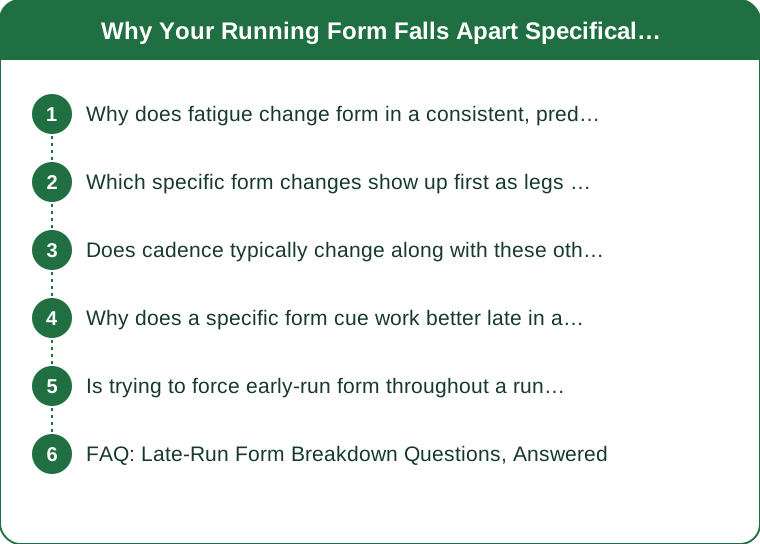
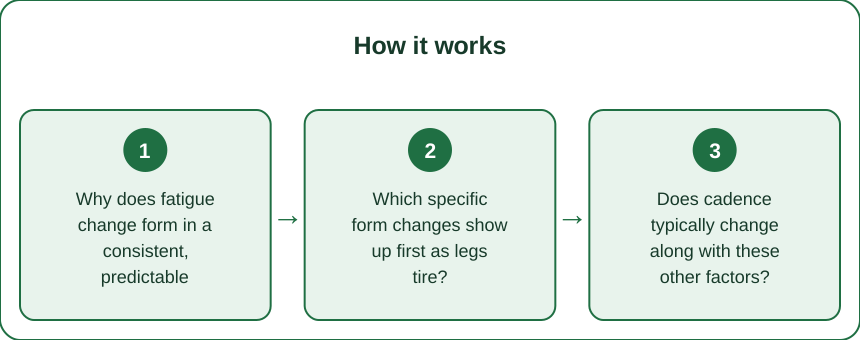
Why does fatigue change form in a consistent, predictable direction rather than randomly?
As primary running muscles (particularly the glutes and calves) fatigue, the nervous system automatically recruits alternative muscle groups and adjusts joint angles to keep the movement going, and this compensation tends to follow a fairly consistent pattern — shorter stride length, increased forward lean, and reduced hip extension — because these adjustments reduce the mechanical demand on the most fatigued muscles specifically.
Which specific form changes show up first as legs tire?
Stride length shortening is often the earliest and most noticeable change, since a shorter stride requires less force production per step; this is frequently followed by increased forward lean as posture control fatigues, and reduced hip extension on the push-off phase as glute capacity diminishes — the order can vary somewhat by individual, but this general sequence is common.
Does cadence typically change along with these other factors?
Often yes, though not always in the same direction — some runners’ cadence drops as fatigue sets in and each step takes marginally longer to execute, while others maintain or even slightly increase cadence while shortening stride length as a compensation strategy, meaning cadence alone isn’t always the most reliable single indicator of fatigue-related form change.

Why does a specific form cue work better late in a run than a general one?
A specific, well-chosen cue (like ‘quick, light steps’ to counter overstriding, or ‘tall posture’ to counter forward lean) gives fatigued muscles and the nervous system a clear, simple target to correct toward, which tends to be more effective than trying to consciously fix every aspect of degrading form at once — late-run fatigue actually makes a single targeted cue more valuable, not less, because attention and coordination capacity are both more limited.
Is trying to force early-run form throughout a run always the right goal?
Not necessarily — some natural adaptation in form as fatigue builds is normal and not inherently harmful, and the goal for most runners isn’t perfectly preserving fresh-leg mechanics until the finish line, but rather preventing the specific compensations (excessive forward lean, significant overstriding) that meaningfully increase injury risk or energy cost beyond what natural fatigue adaptation would otherwise produce.
FAQ: Late-Run Form Breakdown Questions, Answered
Should runners actively fight all form changes as fatigue sets in?
Not all of them — some adaptation is normal and even efficient, but specific patterns like significant overstriding or excessive forward lean are worth actively correcting since they carry a higher injury and energy-cost risk.
Does strength training help delay this fatigue-driven form breakdown?
Yes, meaningfully — building strength and endurance specifically in the glutes and calves, the muscle groups most associated with early fatigue in this pattern, tends to push back the point at which noticeable form breakdown begins.
Is it useful to practice form cues on fresh legs before applying them when tired?
Yes — rehearsing a specific cue during easy, fresh-leg running builds familiarity that makes it easier to recall and apply automatically later in a run when cognitive and physical resources are more limited.
TL;DR:
- Fatigue-driven form changes follow a fairly predictable pattern: shorter stride, more forward lean, less hip extension
- These changes reflect the body redistributing load away from the most fatigued muscles
- A single, specific form cue tends to work better late in a run than trying to fix everything at once
- Some natural form adaptation with fatigue is normal, not something to fully eliminate
- Strength training in key muscle groups can delay when noticeable breakdown begins
Late-run form isn’t falling apart randomly — it’s compensating in a specific, correctable direction.
Keep Reading
This article is for general informational purposes only and is not medical advice. Always consult a qualified health professional for guidance specific to you.