Why Cold Weather Quietly Changes Running Form Without You Really Noticing
Quick Answer: Cold temperatures cause muscles to instinctively tense and contract more, particularly in the shoulders, neck, and upper back, as part of the body’s natural response to conserve heat — this unconscious tension commonly produces a hunched, tighter upper-body posture during cold-weather running that most runners don’t consciously notice happening, even though it meaningfully affects running economy and can increase upper-body fatigue and tension compared to the same person’s warm-weather form.
Cold weather changes running form through an unconscious, protective muscular response, not because a runner is doing anything wrong — but that unconscious shift is still worth actively countering.

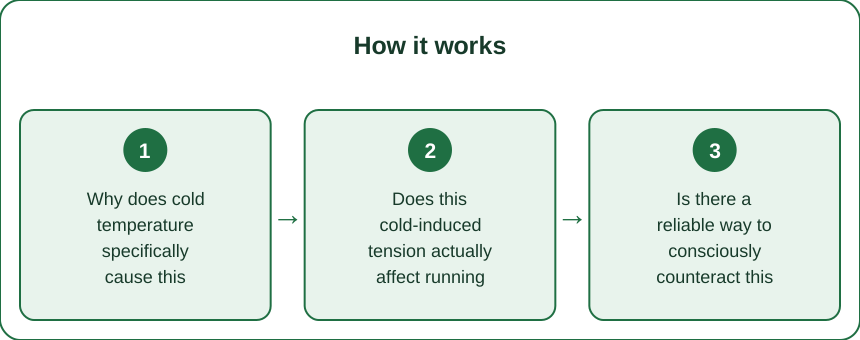
Why does cold temperature specifically cause this unconscious upper-body tensing during a run?
Cold exposure triggers an involuntary muscular response aimed at reducing heat loss and generating some warmth through low-level muscle activity, and this response tends to concentrate in the shoulders, neck, and upper back, producing a hunched, raised-shoulder posture that happens automatically, without conscious intention. This is the same instinctive response behind shivering and generally curling inward in cold conditions, just expressed through running posture specifically.
Does this cold-induced tension actually affect running performance and economy, or is it purely a comfort issue?
It genuinely affects performance — tense, raised shoulders and a hunched upper body reduce efficient arm swing and can restrict full, relaxed breathing capacity, both of which contribute to less efficient overall running mechanics compared to a more relaxed, open upper-body posture. This makes cold-weather form drift a genuine running economy concern, not merely an aesthetic or comfort-level issue.
Is there a reliable way to consciously counteract this unconscious cold-weather tensing during a run?
Periodically and deliberately checking in on shoulder position — consciously dropping and relaxing the shoulders every few minutes — interrupts the unconscious tensing pattern more effectively than simply hoping to notice it happening on its own, since the response is largely automatic and easy to miss without a deliberate check-in habit. A proper warm-up before heading out into cold conditions also helps reduce how much the body needs to rely on this tensing response once running begins.

Does clothing choice for cold-weather running actually influence this tensing response as well?
Yes, to some degree — being genuinely warm enough from appropriate layering reduces how much the body needs to rely on this protective muscular tensing response in the first place, meaning proper cold-weather gear addresses the root cause somewhat, not just the resulting posture. Being underdressed for the actual conditions tends to intensify and prolong this unconscious tensing throughout a run.
What Nobody Tells You About Cold Weather and Running Form
This same unconscious tensing response can also affect breathing pattern, not just posture, since a hunched, tightened upper body restricts full diaphragmatic breathing — some runners who notice feeling more breathless than expected during cold runs, despite similar pace and effort to warmer conditions, are experiencing this same postural-tension effect on breathing mechanics, not necessarily reduced cardiovascular fitness.
FAQ: Cold Weather Running Form, Answered
How often should shoulder position be consciously checked during a cold-weather run?
Many runners find checking in every 5-10 minutes, especially during the first mile before the body has fully warmed up, catches the tensing pattern before it becomes deeply ingrained for the rest of the run.
Does this cold-weather tensing effect lessen once a runner’s body has fully warmed up mid-run?
Yes, generally — as core body temperature rises during the run itself, the protective tensing response typically eases somewhat, though conscious posture checks remain useful throughout, especially in genuinely cold conditions.
Is stretching or mobility work before a cold-weather run helpful for reducing this effect?
A proper dynamic warm-up, rather than static stretching alone, helps prepare the muscles for the activity and can modestly reduce reliance on the cold-tensing response once the run begins.
TL;DR:
- Cold temperatures trigger an unconscious muscular tensing response, particularly in the shoulders and upper back
- This produces a hunched running posture that reduces running economy and restricts efficient breathing
- Periodically checking and consciously relaxing shoulder position interrupts this unconscious tensing pattern
- Appropriate cold-weather layering reduces how much the body needs to rely on this protective response
Cold weather changes running form through a real, automatic physiological response, not carelessness — actively countering it with periodic posture checks keeps running economy closer to warm-weather form.
Keep Reading
This article is for general informational purposes only and is not medical advice. Always consult a qualified health professional for guidance specific to you.